In institutional trading and Smart Money Concepts (SMC), utilizing the SMT Divergence Strategy is one of the most effective techniques for identifying high-probability trend reversals before they happen. Market participants who understand how institutional order flow moves across correlated assets can spot subtle structural cracks long before traditional indicators signal a change in momentum.
Smart Money Tool (SMT) divergence occurs when two strongly correlated assets—such as EUR/USD and GBP/USD, or SPX500 and NAS100—fail to confirm each other’s highs or lows. This non-confirmation reveals underlying institutional accumulation or distribution.
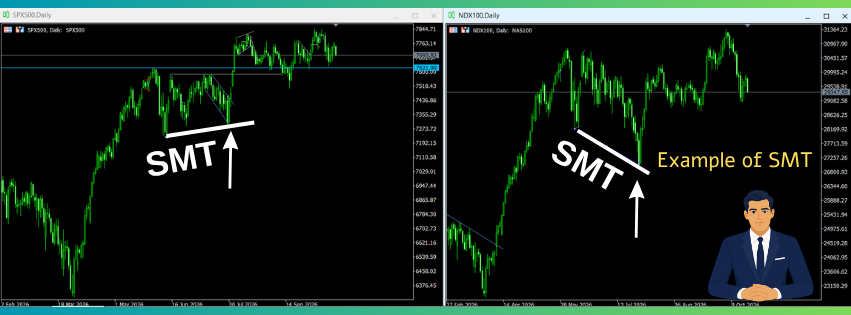
Core Mechanics of the SMT Divergence Strategy
To master the SMT Divergence Strategy, traders must monitor pairs that historically share a strong positive or negative correlation.
Bullish SMT Divergence: Occurs when Asset A makes a lower low, but Asset B makes a higher low. This indicates that institutional buyers are aggressively absorbing sell orders in Asset B, signaling an impending upward expansion.
Bearish SMT Divergence: Occurs when Asset A makes a higher high, but Asset B makes a lower high. The failure of Asset B to break its previous high confirms that smart money is distributing positions into resistance.
By recognizing these structural discrepancies at key liquidity pools, you gain a significant statistical edge in timing your entries.
Trader’s Experience: Spotting Institutional Footprints
Implementing SMT concepts in live prop firm challenges completely changed how I confirm high-timeframe reversals:
“During a high-impact news session on the S&P 500 and Nasdaq, I noticed the SPX500 swept its previous daily high while NAS100 failed to reach its high, creating a clear bearish SMT divergence into a higher timeframe supply zone. Instead of guessing the top, this divergence confirmed that smart money was quietly offloading longs. Taking a short position right after the liquidity sweep yielded a massive risk-to-reward ratio while keeping my drawdown extremely tight.”
How to Trade SMT Divergence Across Cross-Currency Pairs
Applying the SMT Divergence Strategy to correlated forex pairs and cross-pairs requires a systematic four-step execution framework:
Identify Key Liquidity Pools: Mark previous day highs/lows, session liquidity, or equal highs/lows on higher timeframes (H4 or H1).
Scan Correlated Instruments: When price approaches a key zone, compare the price action between correlated assets (e.g., EUR/USD vs. GBP/USD, or EUR/JPY vs. GBP/JPY).
Wait for Non-Confirmation: Confirm that one pair sweeps liquidity while the other fails to make a new high or low.
Lower Timeframe Refinement: Drop to the M1 or M5 timeframe to find an internal Market Structure Shift (MSS) or Fair Value Gap (FVG) for a tight entry.
Practical Advantage for Prop Firm Challenges
For traders attempting to pass proprietary firm evaluations, risk control is paramount. Relying solely on single-chart setups can lead to false breakouts and unexpected daily losses.
Integrating the SMT Divergence Strategy acts as a powerful confirmation filter. It drastically reduces fakeout trades, tightens your required stop-loss placement, and maximizes your risk-to-reward ratio—allowing you to reach evaluation profit targets with minimal drawdown exposure.
Summary: Elevate Your Trading Precision
Mastering the SMT Divergence Strategy allows you to see behind raw price action and align your bias with institutional market drivers. By waiting for non-confirmation at key liquidity levels, you can execute precision entries and manage your account risk with institutional confidence.
